Consultation so far
Phase 1 consultation
The initial phase of consultation began on Monday 12th January and closed on Friday 27th February 2026.
During this period, we shared information about our proposals, held a series of in-person and online events, and invited people to share local insights and their views about the project.
This first consultation phase was an important opportunity for people across the breadth of the project to find out more information and share feedback to help us shape our early proposals.
Additional engagement phase
Our additional engagement phase ran from Tuesday 31st March until Friday 8th May 2026.
Following high public interest in our initial phase 1 consultation, we undertook additional engagement with Wirral communities, to support understanding about the proposals for the project in the area and to gain as much information as possible.
This included hosting a series of webinars and in-person sessions at the Floral Pavilion, producing factsheets about the pipeline and Coastal Above Ground Installation, and responding to common questions raised during our phase 1 consultation.
The feedback received will be reviewed alongside that which we have received as part of our phase 1 consultation, and will inform the next iteration of our project design and our consultation on this, which will be held later in the year.
Our approach to consultation
We understand how important the cement and lime industry is to the region, and also how much the local environment means to the communities living in and around it.
Gaining input from a wide range of stakeholders is critically important and will help us develop a project that is able to anticipate, understand and address potential local impacts.
We want to continue to work closely with communities and organisations to develop an approach that minimises disruption and impact, and ensures work is delivered safely and efficiently
We will listen closely to those who are interested or may be affected by Peak Cluster to hear their thoughts, views and suggestions and let you know how your feedback has shaped our thinking.
Securing consent to deliver Peak Cluster
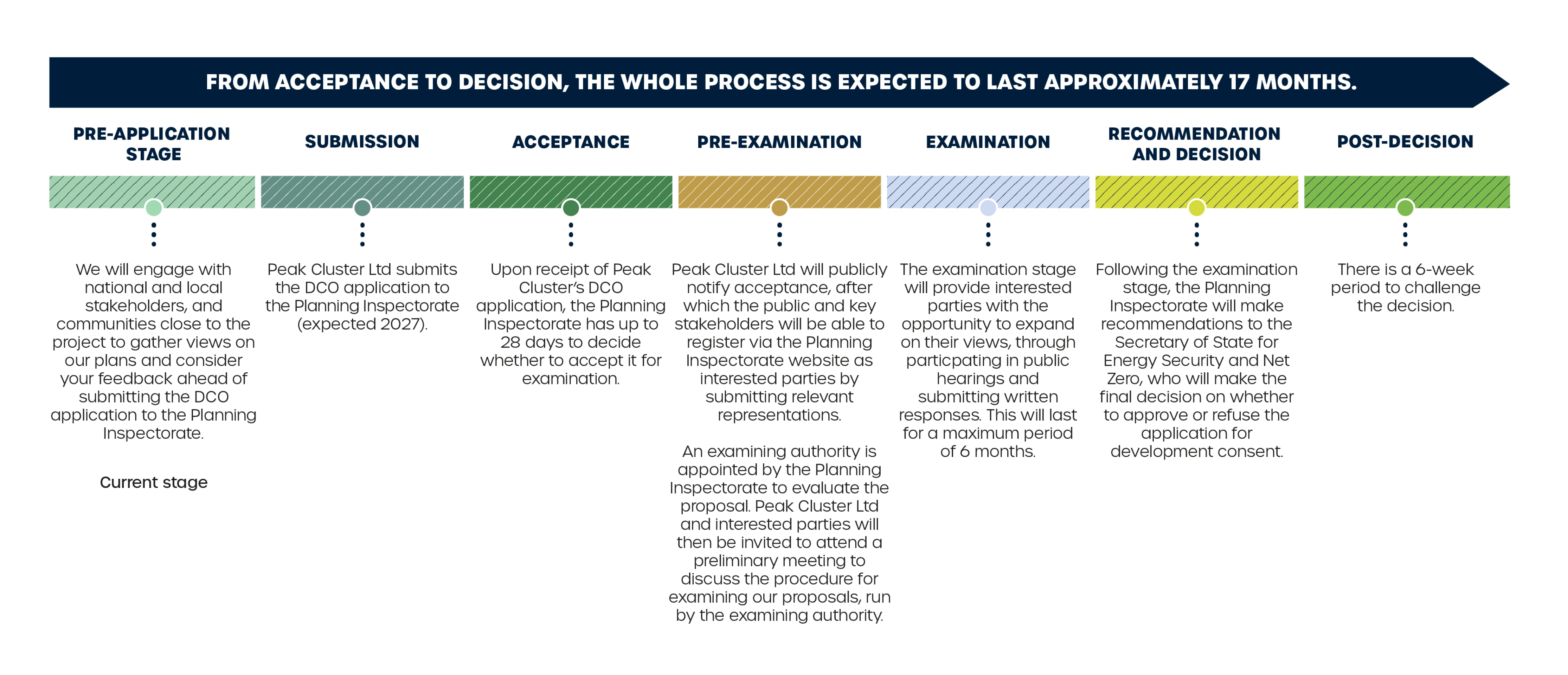
Peak Cluster’s onshore pipeline is classified as a Nationally Significant Infrastructure Project (NSIP). An NSIP is regarded by the UK Government to be of such high importance that consent to construct and operate it must be granted by the Secretary of State for Energy Security and Net Zero.
Peak Cluster Ltd will therefore be required to submit a type of planning application called a Development Consent Order (or DCO) to the government’s Planning Inspectorate. The Planning Inspectorate will examine the application and make a recommendation to the Secretary of State, who will make the final decision on whether the project can go ahead. This consenting process comes under the Planning Act 2008.
Following Royal Assent of the Planning and Infrastructure Act in December 2025, the planning process for NSIPs is changing, and we are expecting to receive new government guidance on the implications of these changes this summer.
Until then, we are following current legislation, government guidance, and best practice in our approach to consultation and engagement.
A key requirement throughout the application process is to consult and engage with national and local stakeholders, communities and landowners, and we take this obligation very seriously. Feedback we receive throughout each phase of consultation and engagement will enable us to refine our proposals ahead of submitting our application to the Planning Inspectorate.
What happens next
We’ve now (September 2026) published the current proposed boundary for the permanent elements of the Project to help you follow how the project is developing. You can view the proposed changes here.
We’ve begun speaking to relevant landowners about the proposed project boundary, to discuss the changes and arrange surveys, and we’ll begin to consult on these changes later this year.
In November, we’ll hold a consultation on the proposed locations for the Project’s pipeline infrastructure including above ground installations and block valve stations, temporary construction areas and access arrangements in Staffordshire, Derbyshire and Cheshire.
Then in January, we’ll hold a consultation on the proposed locations for the Project’s pipeline infrastructure including above ground installations and block valve stations, temporary construction areas and access arrangements on the Wirral.
We’ll share more information on how to get involved in due course.
Overview of the DCO process