Introduction
Thank you for visiting our consultation hub for Peak Cluster.
You can use our consultation hub to learn more about the project, access resources and previous consultation materials, and explore our interactive map.
We’d like to thank everyone who has taken the time to participate in our phase 1 consultation and engagement events, and share feedback and local insights with us via our contact channels.
We plan to launch our phase 2 consultation on the next iteration of the project towards the end of the year.
About Peak Cluster
Peak Cluster is helping to secure the future of Britain’s cement and lime production industry. The project will help to protect existing jobs, and create new roles, while ensuring a reliable and sustainable supply of essential building materials for hospitals, homes, railways, and roads. It will also deliver a home-grown source of low-carbon lime—vital for purifying our drinking water and maintaining healthy soils for grazing livestock and growing crops.
The UK's cement and lime industry, concentrated in Derbyshire and Staffordshire, produces around 40% of the nation's supply. However, the manufacturing process releases significant amounts of carbon dioxide (CO2) the majority of which comes from the raw materials used.
To tackle this challenge, four leading cement and lime producers have joined forces to deliver Peak Cluster. Using proven carbon capture and storage (Carbon Capture and Storage) technology, the project will capture CO2 emissions at source and transport them via a new pipeline for safe, permanent storage beneath the East Irish seabed.
For more information about the project, why we need to deliver it, and those involved in its delivery, check out our project website here.
Project benefits
Peak Cluster will unlock a range of positive impacts – both locally and nationally including:
You can find out more about the project’s benefits in our Project Overview here.
How it works
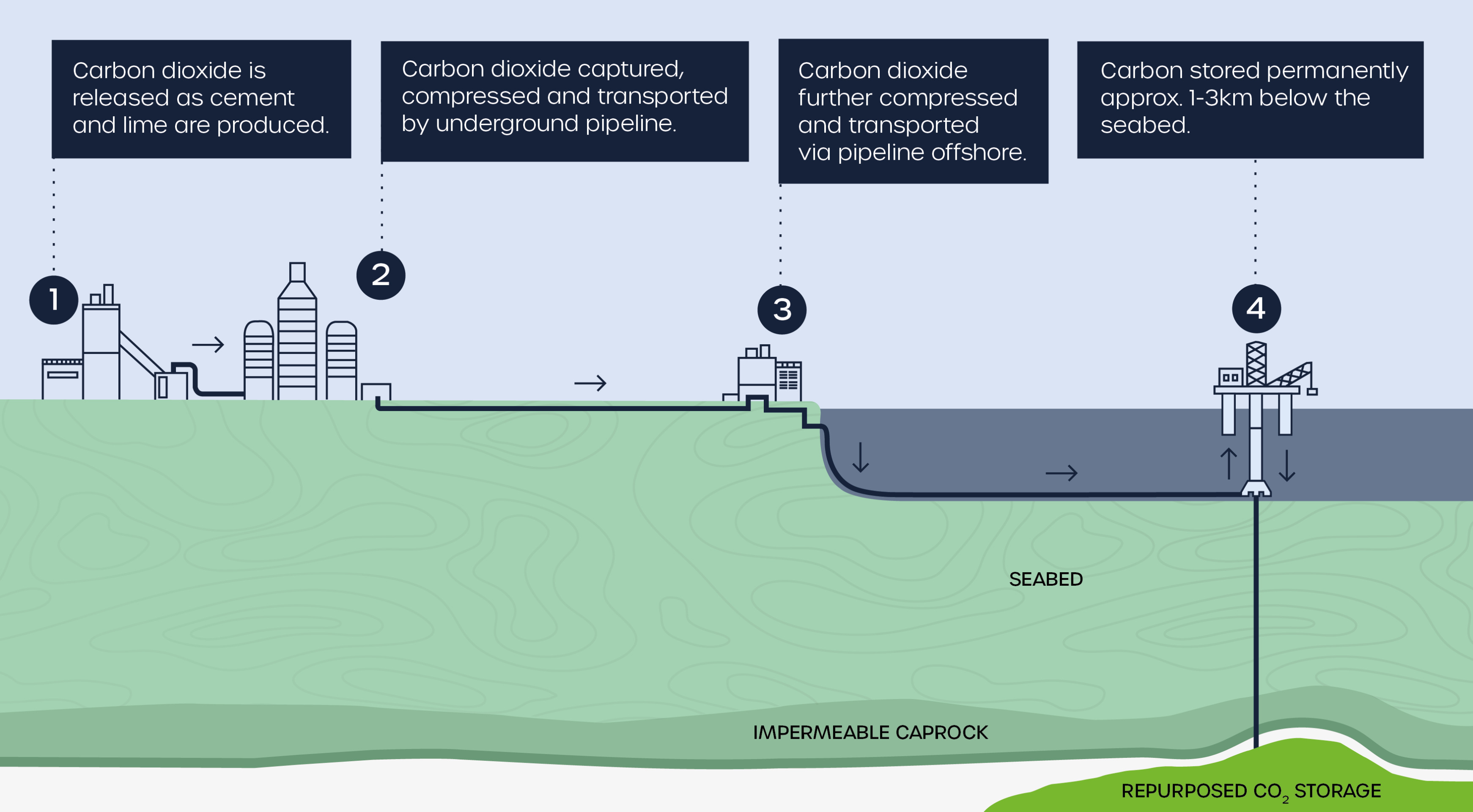
Peak Cluster will use a technology called carbon capture and storage (CCS) to reduce the CO2 emitted as cement and lime are produced, from entering the atmosphere. The CCS process captures the carbon dioxide emissions at their source, before transporting through an underground pipeline to a secure storage site. The CO2, which is currently emitted into the atmosphere when cement and lime are produced, will be captured in purpose-built facilities situated on the cement and lime plants. It will then be compressed so that it can be transported safely by new, purpose-built underground pipelines to Morecambe Net Zero for permanent offshore storage under the East Irish seabed.
More information on the project, carbon capture and storage, the project infrastructure, cement and lime, our approach to protecting the environment, the planning process and the construction process is available in our ‘your questions answered’ of the main website, here.
Sign up to our newsletter
If you would like to stay updated on the project, please enter your name and email address below.